
 |
...... |
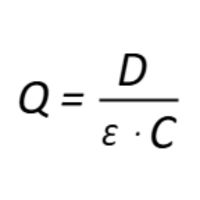
C: Concentración requerida de partículas de un tamaño determinado (contajes/m3); D: Tasa total de emisión de partículas del personal y de los equipos, en (contajes/s); Q: Caudal de aire de impulsión (m3/s); Ɛ:Eficacia de la ventilación (adimensional). |
The most difficult part is estimating parameters D and Ɛ.
The particle emission rate from equipment can be assumed to be very low, since one of the fundamental requirements for equipment and materials entering a Cleanroom is precisely that they should not generate particles. The highest particle emission rate comes from personnel and depends primarily on the garments worn and the level of activity.
Parameter Ɛ is also difficult to estimate, as it depends on the characteristics and location of the air supply and extract points, room geometry, equipment layout and other factors. The use of CFD systems may help with this estimation.
Parameter C would correspond to the particle concentration associated with the ISO class to be achieved, although the standard recommends using a lower particle concentration as an “alert or safety level”. Therefore, for an ISO 7 cleanroom, which permits up to 352,000 particles/m³ ≥0.5 µm, a significantly lower value should be selected for parameter C — for example, one third, corresponding to 117,330 particles/m³, or one quarter, corresponding to 88,000 particles/m³.
In any case, the values of D and Ɛ will always be theoretical and therefore open to debate. ISO 14644-16 proposes supplementing the theoretical calculation with an alternative experimental approach based on actual particle measurements taken in the room under operational conditions. This approach is divided into three stages:
- Design: An airflow rate Q1 is determined based on an initial estimate of particle emissions and ventilation effectiveness. Conservative data can be used for this initial design, since the resulting airflow rate, Q1, is expected to be optimised in the subsequent stages.
- Testing: Airflow rate Q1 is tested in the room under operational conditions and actual concentrations are measured for different particle sizes. Based on the results, a new airflow rate Q2 is calculated, generally lower than Q1, which would achieve the required results.
- Operation: Airflow rate Q2 is used during operation and monitoring data are analysed to confirm that it is appropriate or to optimise it further by establishing a more efficient airflow rate Q3.
In all cases, in addition to achieving the required cleanliness level, the final airflow rate must not compromise other cleanroom parameters such as temperature, humidity and pressure.
This new approach significantly reduces the relevance of the traditional air changes per hour (ACH) concept. The standard itself provides a clear example: two Cleanrooms with the same particle emission sources require the same airflow rate. However, if one has a higher ceiling — and therefore a greater volume — their ACH values will be different, even though the resulting particle concentrations will be similar in both rooms.
Reduced Operation, Shutdown and Recovery
Any airflow reduction should be coordinated with an automatic adjustment of the return air dampers in order to maintain the required relative pressure regime within the room. During periods of inactivity or reduced operation, it is important to keep access points to the room closed to prevent contamination from entering.
Adaptive Control
Once ISO 14644-16 challenges the traditional reliance on air changes per hour (ACH), another concept historically linked to ACH is also called into question: constant supply airflow. Until now, the basic ventilation principles for a Cleanroom have generally been constant supply airflow and variable return airflow for pressure control. However, if supply airflow is determined by particle generation, variations in the particle emission rate also create the possibility of varying the supply airflow.
This introduces the concept of adaptive control. Some sectors require continuous particle monitoring within Cleanrooms; examples include GMP Annex 1 for Grades A and B and the European ECSS aerospace standards for classes up to ISO 8.
Where a continuous monitoring system is available, a control strategy can be established to adjust the supply airflow proportionally to the particle concentrations detected in real time. This is not a simple process: particle counts must be filtered and averaged to provide a stable control signal, while other critical parameters such as room pressurisation and appropriate temperature and humidity control must also be maintained. However, when properly implemented, adaptive control can be one of the most energy-efficient management strategies for Cleanrooms.
Air Velocity Reduction
In unidirectional airflow (UDAF) systems, the determining factor is not airflow rate but air velocity. The value of 0.45 m/s ±20% (0.36–0.54 m/s) has remained largely unchanged since it was established by the US Air Force in the 1960s and subsequently incorporated into the long-standing US FED-STD-209 standard.
ISO 14644-16 suggests applying the same principle used to reduce airflow in turbulent-flow installations by reducing the velocity of UDAF units during periods when there is little or no activity beneath them. The standard indicates that under low-activity or inactive conditions, velocity could be reduced to approximately 0.2–0.3 m/s.
The standard also suggests assessing the possibility of switching off UDAF units installed within Cleanrooms during periods of inactivity. In general, the airflow delivered by a UDAF unit is significantly higher than the airflow rate of the Cleanroom in which it is installed, meaning that the resulting energy savings can be considerable.
Fans
For a reduction in airflow to translate into actual energy savings, fans must be capable of converting lower airflow requirements into lower energy consumption without significant mechanical or efficiency losses. When selecting fans for a Cleanroom, the following should be considered:
- High efficiency: to translate airflow reductions into energy savings.
- Variable speed: to enable effective control of the required airflow.
- Direct drive: to avoid transmission losses between the motor and the fan impeller. Conventional belt-and-pulley drives, even when in good condition, can account for between 10% and 15% of total motor energy consumption. With worn or poorly tensioned belts, these losses can be considerably higher.
Filters
Air filters are an essential component of Cleanrooms. High filtration efficiencies result in higher pressure drops, and pressure drop is directly related to the energy required to overcome it. Pressure drop is proportional to the square of velocity, while velocity is related to the cube of power. Therefore, reducing pressure drop by 50% can reduce fan power by a factor of 2.8.
Excessive use of filters increases the energy cost of the installation. ISO 14644-16 recommends adopting a lifecycle approach to filter replacement, using energy efficiency as a criterion. In other words, filters should be replaced when the additional energy cost resulting from increased pressure drop exceeds the amortised cost of installing a new filter.
Thermal Loads
Heating and cooling loads are another major source of energy consumption in a Cleanroom. ISO 14644-16 recommends addressing the energy efficiency of thermal loads from several perspectives:
- Reducing thermal loads: By improving the effectiveness of insulation from the external environment and rationalising internal loads, including assessing how internal heat sources can be minimised or isolated.
- Optimising setpoints: By selecting setpoints and acceptable operating ranges that reflect the actual requirements of the room. ISO 14644-16 highlights the possibility of allowing relative humidity to fluctuate between 30% and 70% where humidity control is required solely for occupant comfort. More flexible temperature and humidity setpoints are also recommended during periods of low occupancy or at-rest conditions.
- Optimising outdoor air: Outdoor air intake is one of the largest contributors to the thermal load of a Cleanroom HVAC system. The outdoor airflow rate should be calculated and justified according to pressurisation, oxygenation and ventilation requirements. It is very common to determine outdoor airflow as a percentage of the total supply airflow. According to ISO 14644-16, this practice has no rational basis, does not improve Cleanroom quality and represents a source of energy inefficiency.
Unfortunately, in the Spanish version published by AENOR, “Fresh Air”, meaning outdoor or make-up air, has been incorrectly translated as “aire limpio” (“clean air”). As a result, some concepts, such as the Air Change Effectiveness (ACE) and recommendations for reducing outdoor airflow, become confusing and difficult to interpret in the Spanish text. Two different concepts are presented under the same term: in some sections, “aire limpio” refers to filtered air with a low particle concentration, while in others it refers to outdoor make-up air.
Conclusions
ISO 14644-16 is a highly useful document for rationalising and reducing energy consumption in Cleanrooms. It provides a well-structured, evidence-based methodology covering the different factors that influence Cleanroom performance. Its methodology can be applied both to new or refurbished facilities and to existing facilities already in operation.
For industries that rely on Cleanrooms, ISO 14644-16 provides an essential framework for maintaining viable operating costs, accessing grants or incentives linked to energy-efficiency criteria, and supporting corporate sustainability and social responsibility policies.