Introduction
The primary purpose of a Cleanroom or Clean Area is to isolate operations and processes from the external environment, which is considered uncontrolled and a significant potential source of contamination. However, the nature of these operations and processes requires continuous interaction with the outside environment, both for the transfer of raw materials and other materials into the Cleanroom and for the removal of finished products and waste. This continuous interaction with the external environment, or with lower-grade areas within the Clean Area itself, is one of the main potential sources of contamination and therefore one of the key considerations when designing a Clean Area.
GMP Annex 1 defines an airlock as an enclosed space with interlocked doors, designed to provide physical separation and maintain air pressure control between adjacent rooms, generally with different air cleanliness standards. The purpose of an airlock is to prevent particulate and microbial contamination from entering from a less controlled area. Therefore, whenever there is a change in GMP grade between rooms, an airlock must be provided.
Annex 1 also defines a pass-through hatch as a form of airlock, although it is generally smaller in size.
In general, an airlock is considered to be a room: an enclosed space with sufficient internal dimensions and access for a person to enter. A SAS (Sterile Access System), also referred to as a pass-through hatch, material pass-through or transfer chamber, is a smaller airlock whose internal dimensions and door sizes physically prevent a person from entering.
As a general rule, material airlocks should be separate from personnel airlocks. Where this is not physically possible, the arrangement must be justified and procedures implemented to prevent contamination. These procedures should ensure that personnel and material transfers are separated in time and that the airlock is cleaned and decontaminated before changing from one use to the other.
Regardless of their size, airlocks must be supplied with actively filtered air of sufficient quality to maintain the required grade. Air supplied from another room, even if that room is classified, is not considered to be of sufficient quality unless it has undergone filtration before entering the airlock.
At rest, an airlock must achieve the same grade as the room it leads into. For this reason, every airlock requires filtered air to achieve the required classification. Even a hatch-type SAS connecting to a Grade D room should achieve Grade D conditions at rest and therefore be supplied with filtered air.
An interlock is an electromechanical or electromagnetic device that can physically prevent one door from opening while the opposite door is open. Airlock and SAS doors leading to Grade A or B areas must be interlocked to prevent simultaneous opening. For Grades C and D, a door-opening control system using visual indicators, such as traffic lights, or audible alarms is permitted.
Where necessary, a delay can be introduced before the access door is released, ensuring that the required cleanliness conditions have been restored inside the airlock before the door to the higher-grade room is opened.
Airlocks
Material Airlocks
The primary purpose of an airlock is to protect the room it provides access to. The level of protection provided by the airlock should therefore be proportional to the cleanliness grade of that room.
Unlike personnel changing rooms, material airlocks do not need to follow progressively higher cleanliness grades. A material airlock may connect a Non-Classified Area directly to a Classified Area in a single step, using a double-door arrangement, provided that sufficient protection is ensured, for example through ultrafiltered air, chemical decontamination, unidirectional transfer or other appropriate measures.
Material Airlocks for Grade A or B Areas
Grade A/B areas are the most critical environments within aseptic processing. Limits for viable particles — microorganisms capable of growth — are extremely stringent: 0 CFU (colony-forming units) for Grade A and 10 CFU in air or 5 CFU on settle plates for Grade B.
Material transfer into Grade A/B areas is therefore one of the most critical activities within an aseptic process and can compromise the microbiological classification of the A/B environment.
To minimise the risk of contamination, material airlocks serving Grade A/B areas should preferably be unidirectional, meaning that they are used in only one direction, either for entry or for exit.
Materials entering Grade A or B areas must be sterilised. This can be achieved using steam autoclaves or dry-heat sterilisation/depyrogenation ovens. Where sterilisation is not possible because the materials could be damaged by heat, an alternative system must be used to achieve the same objective of preventing contamination from being introduced. This generally involves a double-door airlock with a chemical disinfection system designed to reduce the bioburden.
Where materials cannot be sterilised during transfer using an autoclave or oven, they must be supplied sterile and protected by double or triple sealed packaging. In this case, the airlock must ensure biological decontamination of the outer surface of the packaging.
The number of packaging layers should be at least equal to the number of different grade transitions through which the material must pass. The final transfer into the Grade A/B area should involve chemical decontamination or a process, generally automated, that allows the outer packaging layer to be removed without contaminating the sterile inner layer. The decontamination process, or the sterility of the transfer process, must be validated.
For materials leaving Grade A or B areas, a decontamination process is not required, but it must be ensured that the airlock chamber recovers Grade B classification after the exit process.
If the same airlock is used for both incoming and outgoing materials, the two operations must be separated in time and appropriate decontamination controls implemented to protect the Grade A/B area at all times, particularly before the airlock is used again to introduce sterile materials. In such cases, cleaning and decontamination procedures — whether automatic or manual — must be defined and validated and carried out after outgoing transfers and before subsequent incoming transfers.
Material airlocks do not need to follow a progressive sequence of cleanliness grades. A material airlock may connect a Grade A/B area directly with a Grade D or even a non-classified area, provided that cleaning and decontamination procedures appropriate to the identified risk have been defined and validated.
Material Airlocks for Grade C and D Areas
Airlocks must also be used to transfer materials into Grade C and D areas. Their characteristics should be defined on the basis of a risk assessment for the area they serve.
Requirements are less stringent than for airlocks serving Grade A/B areas, but as a minimum they should have door-opening indicators and an active filtered air supply. Additional measures, such as automatic or manual disinfection, may be incorporated depending on the risk assessment and the Contamination Control Strategy (CCS).
Airlock
This type of airlock is connected to the HVAC system and can therefore maintain a GMP classification and a differential pressure. Although it is capable of maintaining a defined internal cleanliness grade, opening the door on the “dirty” side affects the classification within the airlock.
It is therefore advisable to implement a system that ensures the airlock has recovered its specified cleanliness grade before the door on the “clean” side can be opened. This can be achieved by combining the door interlock system with a time delay that prevents the clean-side door from opening until the airlock has recovered its required classification. A recovery test performed during validation can be used to determine the appropriate delay time.
Another consideration with this type of airlock is the possibility of personnel entering the chamber. As a general rule, material airlocks must not be used for personnel access.
The fundamental difference between personnel and material airlocks, in addition to their intended use, is that personnel airlocks consist of several successive stages through consecutive grades, such as D–C–B, because personnel move independently from one stage to the next. Material airlocks, by contrast, generally consist of a single transfer stage because materials must be moved by personnel, and those personnel should not cross successive areas involving a change in grade without undergoing the corresponding gowning procedure.
The general material transfer process therefore involves two people positioned on opposite sides of the airlock. One person introduces the material from the lower-classification or “dirty” side, entering the airlock as little as possible, while another person retrieves it from the higher-classification or “clean” side, also minimising entry into the chamber. Because the doors are interlocked, both people cannot be inside the airlock at the same time.
Decontamination Airlock
In some cases, HEPA filtration of the airlock air alone is not sufficient. This is particularly relevant for materials entering Grade A/B areas, where a reduction in bioburden is required.
This reduction is generally achieved by fumigation using a suitable decontaminating agent, such as hydrogen peroxide, peracetic acid or glutaraldehyde, among others.
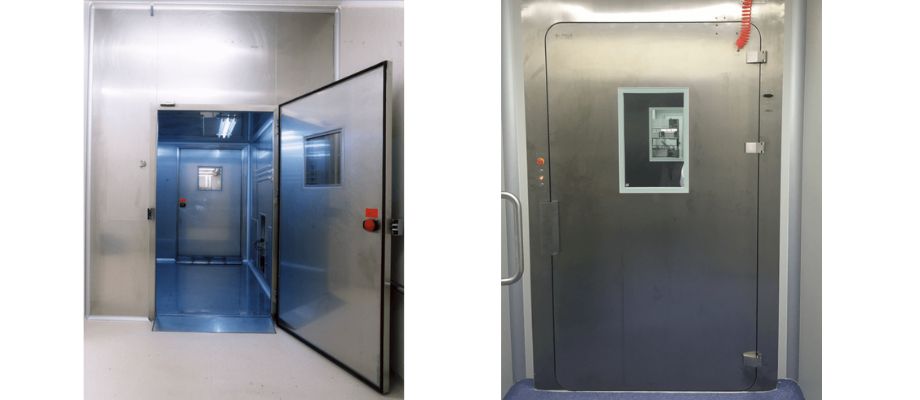
[Fig. Hermetic Door with Ramp and Airlock for an Inflatable-Gasket Door.]
In this case, the SAS must be equipped with a series of additional features to ensure that sanitisation can be carried out effectively and safely:
- Hermetically sealed doors to prevent fumigation agents from escaping into occupied areas in the rooms adjacent to the airlock. These doors typically use inflatable gaskets operated by compressed air, providing an airtight seal against the floor without the need for a raised threshold. This allows trolleys and wheeled containers to move easily into and out of the airlock. Where inflatable-gasket doors are not used, submarine-type doors with a raised threshold are required, allowing the bottom of the door to seal against it. In this case, a manually operated folding ramp must be installed to provide access for trolleys or wheeled containers.
- HEPA-filtered aeration system to remove the sanitising agent before the discharge-side door is opened, protecting personnel from exposure.
SAS
Pass-Through SAS
Also known as a material pass-through or pass-through hatch, this is the simplest type of airlock. Its effectiveness is based on the use of two or more interlocked doors, or doors fitted with indicators, that are opened alternately, without any internal air treatment.
This type of airlock is not permitted under GMP Annex 1 for the transfer of materials into classified rooms, as it does not have an active air supply within the chamber. Active filtered air is a fundamental requirement established by Annex 1 for all airlocks communicating with GMP-classified areas, from Grade A to Grade D.
Dynamic SAS
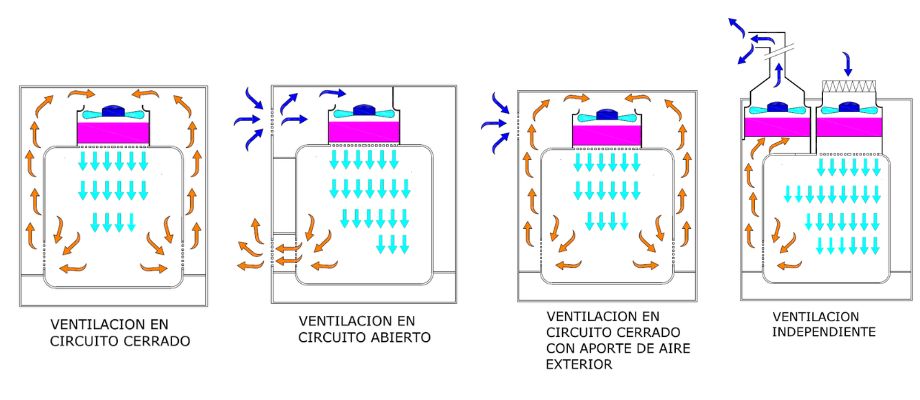
To comply with GMP Annex 1 requirements, SAS units must be continuously flushed with HEPA-filtered air. These are commonly referred to as dynamic SAS and can be configured in several different ways.
Dynamic SAS Connected to the HVAC System
This configuration essentially operates as a miniature cleanroom. It features a HEPA filter at the top of the chamber connected to the HVAC supply air system, together with a low-level or floor-mounted return grille connected to the HVAC return air system.
It operates continuously as an integral part of the HVAC system. No decontamination process, whether automatic or manual, can be carried out within this type of SAS, as the fumigation agent would be distributed through the HVAC system to the other rooms.
Closed-Loop HEPA Recirculation SAS
This configuration essentially operates as a miniature cleanroom. It features a HEPA filter at the top of the chamber connected to the HVAC supply air system, together with a low-level or floor-mounted return grille connected to the HVAC return air system.
It operates continuously as an integral part of the HVAC system. No decontamination process, whether automatic or manual, can be carried out within this type of SAS, as the fumigation agent would be distributed through the HVAC system to the other rooms.
Open-Loop HEPA Recirculation SAS
The SAS ventilation system draws air from one of the rooms, normally the “dirty” side, passes it through a HEPA filter and returns it to the same “dirty” room through a low-level grille. This system achieves the required cleanliness grade within the chamber and maintains the SAS at a higher pressure than the “dirty” room. However, there is an open connection between the SAS chamber and the “dirty” room through the air discharge grille.
When the door on the “clean” side is opened, a direct connection is created between the “clean” and “dirty” areas through the chamber and the air discharge grille, even if the “dirty”-side door remains closed and interlocked. With the ventilation system operating continuously, the clean airflow prevents contamination from migrating from the “dirty” area towards the “clean” area. However, if the ventilation system stops, there is a potential risk of contamination.
Closed-Loop Recirculation with Air Intake
In some cases, the recirculation system is supplemented by a small air intake from the “dirty” area upstream of the HEPA filter, helping to maintain positive pressure within the SAS chamber.
This configuration is similar to the previous one: while the system is operating, the pressure regime and airflow prevent contamination from migrating from the “dirty” area to the “clean” area. However, if the ventilation system stops, there is a potential risk of contamination.
Independent Ventilation without Recirculation
In this configuration, the ventilation system is completely independent of the adjoining rooms. Air is drawn from a technical area through a pre-filter and supplied to the chamber by means of a fan and a HEPA filter. Air is then extracted from the chamber through a second HEPA filter and exhaust fan and discharged outside.
By adjusting the fan speeds, the pressure within the chamber can be balanced and maintained at a specified value. In theory, the extract HEPA filter would not be essential, but its use is highly recommended to prevent external contamination from entering the chamber through the extract duct and grille when the fans are switched off.
An independent ventilation system allows the fans to remain switched off when the SAS is not in use and to operate only during transfer activities. It also allows the extract fan to remain off while the “dirty”-side door is open, so that all clean air supplied to the chamber flows towards the “dirty” area, preventing contaminated air from entering the chamber.
Similarly, when the “clean”-side door is opened, the extract fan remains in operation, preventing air from the chamber from flowing into the “clean” area.